
Interview with Island Conservation

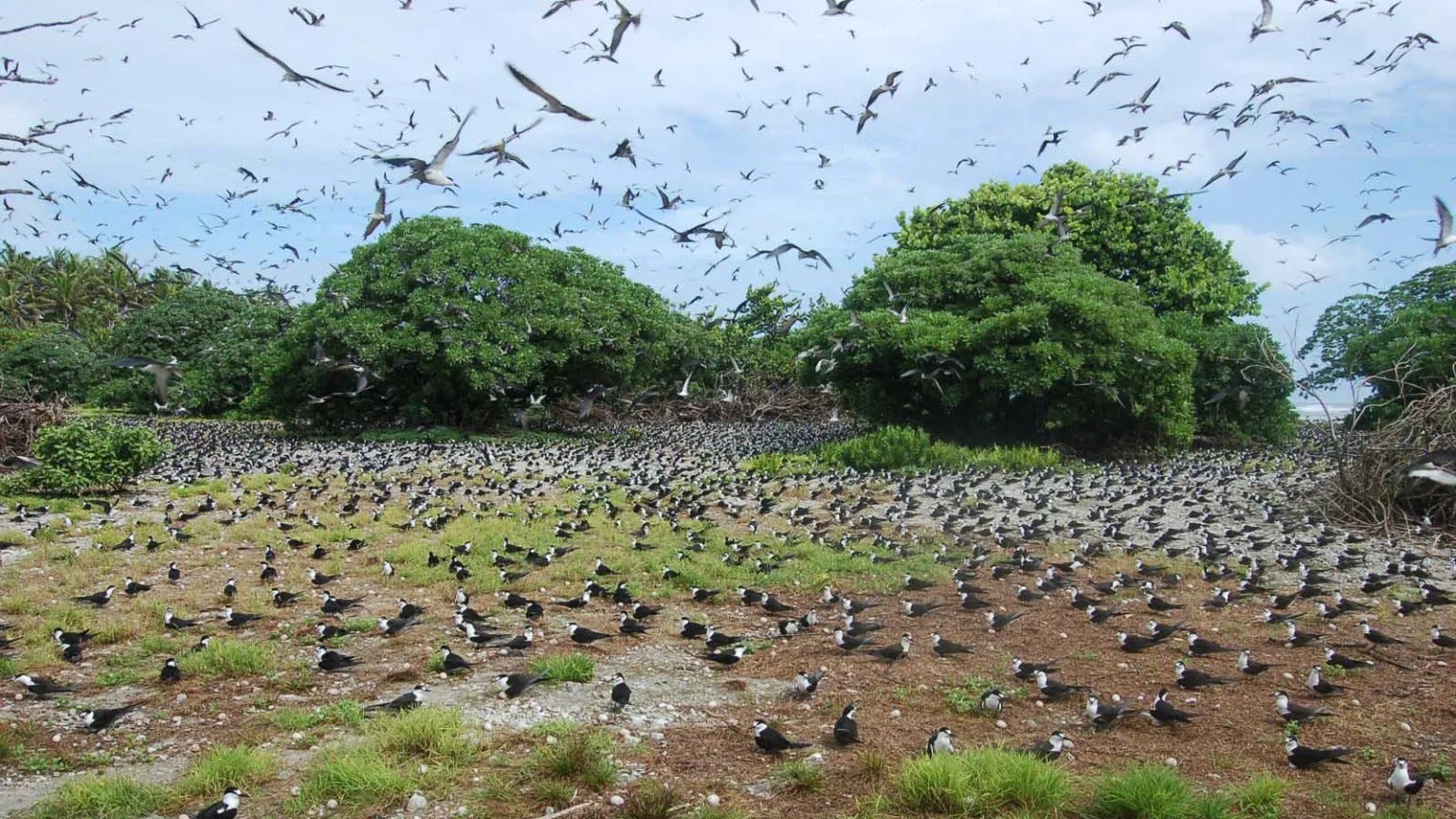
A sooty tern colony on Palmyra Atoll National Wildlife Refuge, recovered by brodifacoum-laced bait applied by Island Conservation, The Nature Conservancy and the U.S. Fish and Wildlife Service photo © Susan White/USFWS
Island Conservation: You’ve been a long-time friend of Island Conservation. What first drew you to our mission of restoring island ecosystems?
Ted Williams: Seventeen years ago, Audubon Magazine assigned me to write a piece on the rodenticide treatment of 6,861-acre Rat Island in the Aleutians. There was by-kill of bald eagles, and I think Audubon wanted a critique.
I didn’t get far into my research before I discovered that the by-kill, while alarming, was ecologically irrelevant and that the project needed public support, not criticism. My editor let me tell the real story.
The island, originally called Hawadax, was renamed Rat Island shortly after 1780, the year a Japanese ship ran aground and disgorged Norway rats that spread like a virus. The alien rats devoured adult birds, nestlings, eggs, seeds and plants, eliminating much of the native vegetation and most of the island’s songbirds, shorebirds, and seabirds. Visiting biologists described the place as “eerily silent.” Rat Island’s status as part of the Alaska Maritime National Wildlife Refuge, established in 1980, was a sick joke.
But in 2008, the U.S. Fish and Wildlife Service, in partnership with Island Conservation and The Nature Conservancy, saturated Rat Island with brodifacoum-laced bait. Early snow covered and preserved the bait. Bald eagles, off their routine of feasting on distant salmon, ate some of the dead rats and succumbed to secondary poisoning. Some glaucous-winged gulls died, too. Opponents of all poisons in all situations called (and still call) the project a “disaster.”
I learned that, despite the atypical by-kill, the project is a stunning success. Today, the island, again called Hawadax, is rat free. Local eagles have long since recovered; gulls have more than recovered; and an entire ecosystem, including native plants and birds rarely if ever seen for 230 years, has been reborn. Surging back have been species including giant song sparrows (found only in the Aleutians), tufted puffins, black oystercatchers, rock sandpipers, Leach’s storm petrels, snow buntings, Pacific reed grass, longan sedge, and crowberry.
The Rat Island experience taught the partners much about how to minimize by-kill of nontargets, but they can’t always eliminate it. Never is by-kill ecologically relevant. Much of the public has difficulty grasping this fact.
U.S. Fish and Wildlife Service biologist Dr. Beth Flint, who has worked on successful rodent eradications on Pacific islands, likens brodifacoum to chemotherapy for cancer. “You know you’re going to incur collateral damage,” she says. “Good cells will die, and you’ll be sick. But it’s worth it. People are being misguided. We have to respond to every Freedom of Information Act request. That’s hundreds of hours gathering documents because opponents are fishing for anything that might show that agency people have done something improper. It takes away our already extremely skeletal staff to answer people who don’t understand science.”
Since then, I have written extensively about the desperately needed work of Island Conservation. A few examples:
https://blog.nature.org/2020/01/22/recovery-zombie-mouse-apocalypse/
https://blog.nature.org/2019/06/25/recovery-victories-in-galapagos-national-park/
https://blog.nature.org/2018/02/26/recovery-evicting-rabbits/
https://www.hatchmag.com/articles/chemophobia-america-part-ii-brodifacoum/7714790
https://blog.nature.org/2017/11/06/recovery-the-salvation-of-desecheo-national-wildlife-refuge/
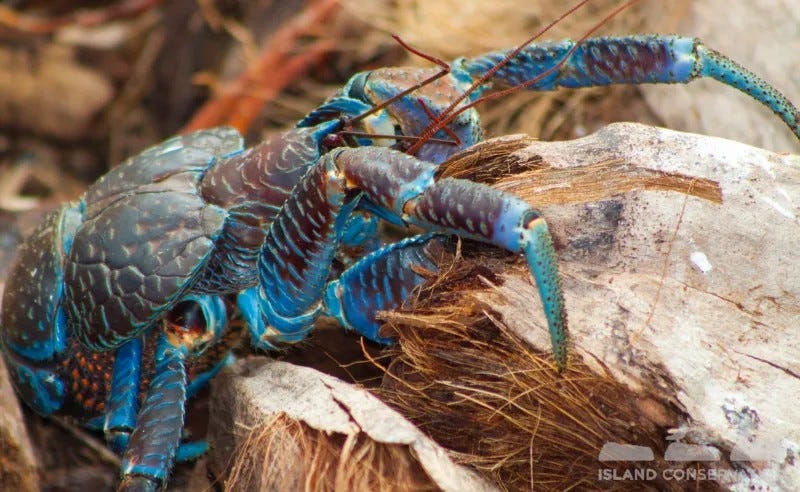
A coconut crab, the world’s largest invertebrate, can weigh 15 pounds and live as long as a human. Coconut crabs and nine other species of land crab were recovered on Palmyra Atoll National Wildlife Refuge by brodifacoum-laced bait applied by Island Conservation, The Nature Conservancy and the U.S. Fish and Wildlife Service. These land crabs maintain the refuge’s plant community by dispersing seeds, breaking down organic matter and mixing soils. Invasive rats had nearly eliminated all ten species. Photo © Island Conservation.
IC: Your writing challenges popular narratives about conservation by inviting people to think beyond individual animals to entire ecosystems. What’s the biggest pervasive misconception people have about environmental restoration?
TW: There are many pervasive misconceptions, but I am most distressed by the public’s ignorance of and lack of appreciation for native species and native ecosystems. Without poisons like brodifacoum, rotenone and herbicides, the battle to save fish and wildlife from extirpation and possible extinction by invasive, nonnative species is lost.
Fear and loathing of all poisons in all situations is, alas, a global phobia. Whenever brodifacoum is used to save native wildlife, these are the standard objections, and I quote from reader comments in response to my articles:
“There has to be a better way.” “The nonnative species didn’t ask to be put there.” “Other [nontarget] wildlife will die.” “Killing one species in favor of another is wrong.” “Poisoning animals is cruel.” “Island Conservation is playing God.”
There is no “better way”; in fact, there is no other way. That “nonnative species didn’t ask to be put there” is no reason to allow them to remain and thereby usher native species into oblivion. While there has been by-kill of nontarget wildlife, it has had no significant or permanent effect on any population anywhere, and it is steadily diminishing. “One species” has never been killed “in favor of another”; individuals of introduced, nonnative species have been killed to save entire native species. “Poisoning animals” is nowhere near as cruel as allowing native wildlife to starve or be slowly gnawed to death (see this video, but not before you eat). Correcting our past mistakes (instead of sitting on our hands and watching island ecosystems get trashed as a result of those mistakes) is not “playing God.”
Public attitudes about rotenone, an organic poison used for centuries by South American indigenous peoples to kill fish for consumption, mirror those about brodifacoum. Rotenone has no effect on non-gilled organisms. It has a brief half-life, is applied to running water at 50 parts per billion, is easily neutralized downstream of project areas, and in modern fisheries management, has never been seen to permanently affect a native aquatic ecosystem except to restore it.
Below is a letter to Writers on the Range, expressing concerns about my advocacy for use of rotenone, which is usually the only tool available to save imperiled native fish from being wiped out by introduced, non-native fish. The letter encapsulates public misconceptions that confront fish and wildlife managers:
“Dear editor, regarding Ted Williams’ attack on ‘mongrel trout’: Most Americans believe there is nothing wrong with human genetic mixing! I am a mongrel of sorts myself and delight in my diversity. Many humans naturally find attractive members of different races and ethnic makeup. We Americans champion the freedom to love whoever we choose to love. We see this as consistent with natural selection and the evolution of man. We abhor those who seek human genetic purity! American military men and women have died and continue to die for the freedom of others oppressed by those who wish to impose the same limitations on man as you are seeking to impose on trout. One could argue that what you champion is an environmental form of ‘ethnic cleansing’ or the Nazi equivalent of racial purity. ‘Purity,’ I am uncomfortable with that word! ‘Purity’ is a word often used by racists, Nazis and bigots. ‘Purity,’ that word is very much part of the argument to restore the Paiute cutthroat trout.”
-- Robert Skowronski., Sharon, VT
My response: Dear Mr. Skowronski: Genetic swamping by alien rainbow trout threatens to excise our rarest and most endangered salmonid, the Paiute cutthroat, from the planet. Unless your progenitors have successfully bred with, say, chimpanzees, the “genetic diversity” you delight in does not include this kind of interspecies hybridization.
Finally, there is a discipline (more accurately, a “cult”) called “Compassionate Conservation.” Decades old, but named in 2013, it is neither compassionate nor conservation. It prioritizes individual animals at the expense of species and native ecosystems. Practitioners imagine and proclaim that conservation goals can be achieved without any lethal control of invasive, nonnative species. And they argue that invasive nonnative species often “improve” ecosystems. My 2 cents here.
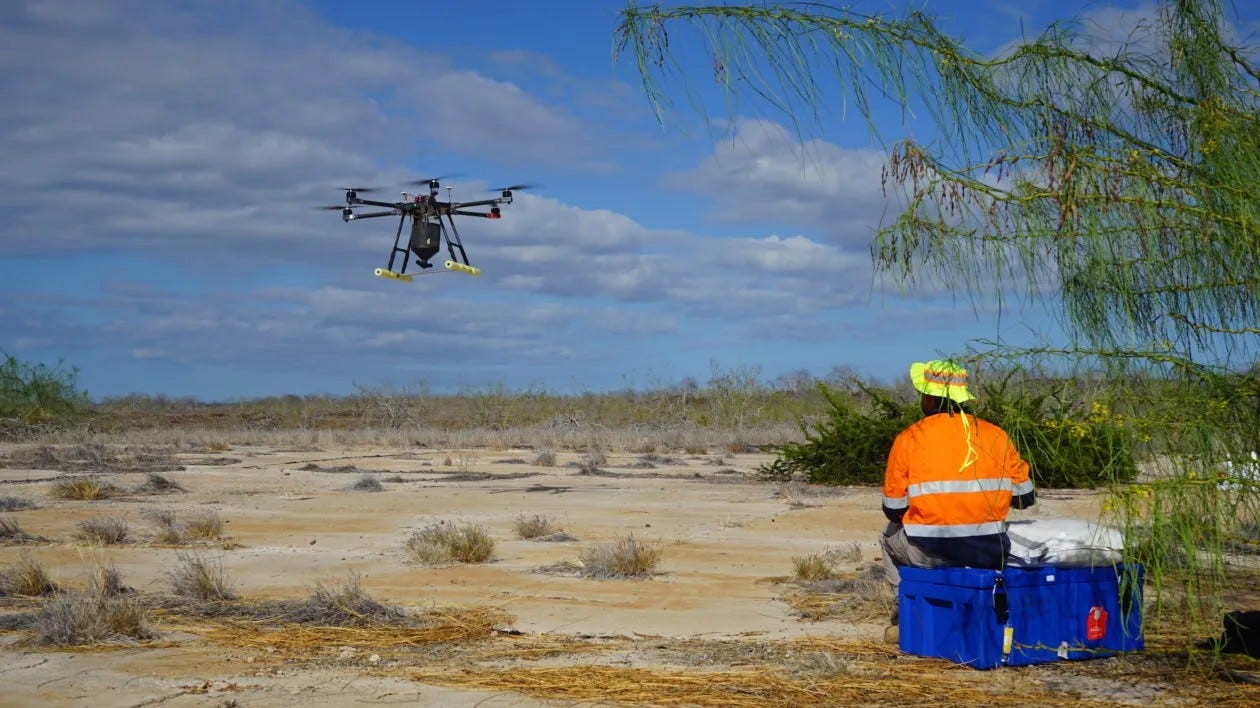
One of the six-rotor drones used to spread brodifacoum-laced bait over North Seymour and Mosquera Islands. Photo © Island Conservation
IC: What role does storytelling play in shifting public opinion on these complex conservation issues?
TW: I try to tell the story by leading readers into articles gradually, rather than blurting out everything I know in opening paragraphs. I back up all my points with quotes from trained fish and wildlife professionals. And I try to provide specific examples of fish and wildlife recovery with before-and-after evidence. Good photos are essential, especially when making the case that the alleged “cruelty” of poisoning nonnative invasives is imagined and that the real cruelty is allowing nonnative invasives to extinguish native ecosystems. I can’t think of more effective photos than the ones the U.S. Fish and Wildlife Service provided for my piece entitled “Zombie Mouse Apocalypse.” These photos do the storytelling better than I or any writer can. See them here: Recovery: Zombie Mouse Apocalypse.
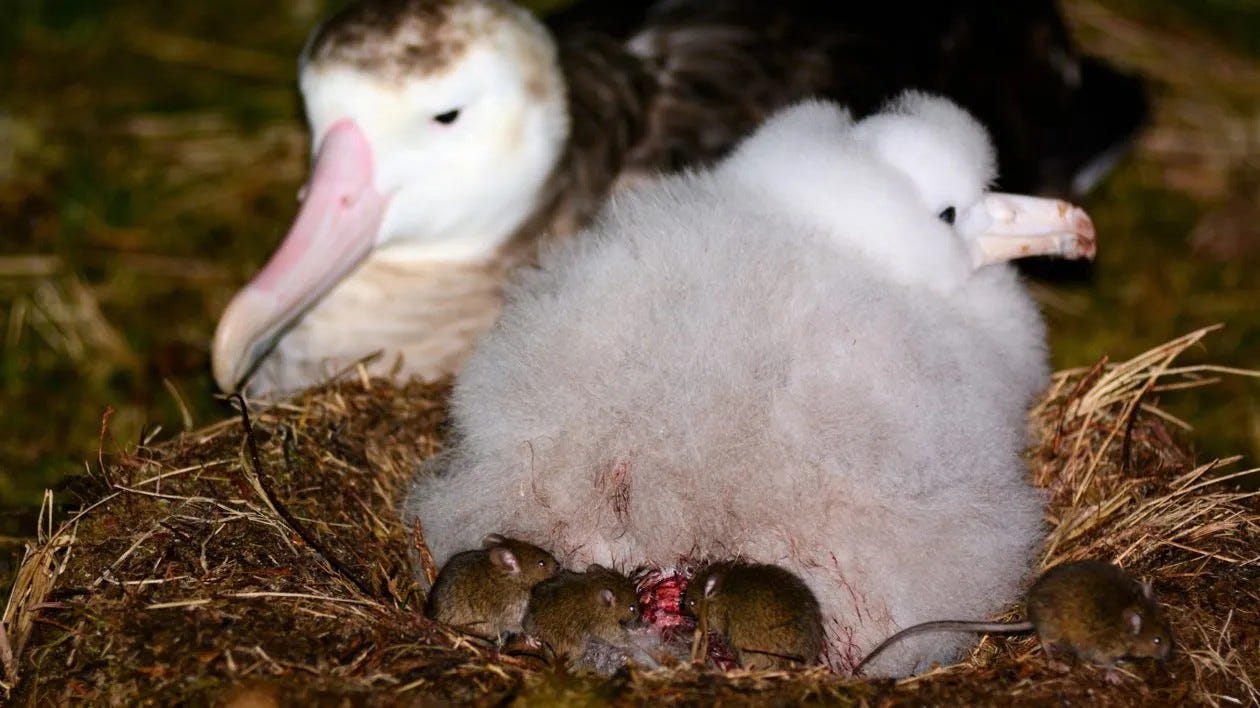
A critically endangered Tristan albatross chick being eaten alive by invasive mice on Gough Island, a World Heritage Site. Photo © MJones / Royal Society for the Protection of Birds
IC: What island restoration project sticks with you the most, and what lesson from that project do you feel is most important to carry through to future restoration efforts?
TW: I guess it’s always the last project I wrote about that sticks with me the most. The lesson from each is the same. It is this: Playing musical chairs with species inevitably results in ecological catastrophe. And removing nonnative species is difficult, expensive, controversial, and on the mainland usually impossible.
Much of the public, including much of the environmental community, can’t keep these two thoughts in their minds simultaneously: 1. On the mainland, brodifacoum is a lethal poison grossly abused by the public and even professional pesticide applicators. 2. On islands, the lethality of brodifacoum renders it the only tool trained wildlife professionals have for eradicating invasive species. You have to kill them all. If one male and one female survive or if a single pregnant female survives, recovery fails.
Sadly, recovery projects for island wildlife are hampered by brodifacoum’s vile reputation acquired by gross public abuse on mainlands throughout the world. Any ban on brodifacoum must not include its use on islands by trained wildlife professionals. “Bring us something else that will work; we will be the first to adopt it,” declares Island Conservation’s Gregg Howald.
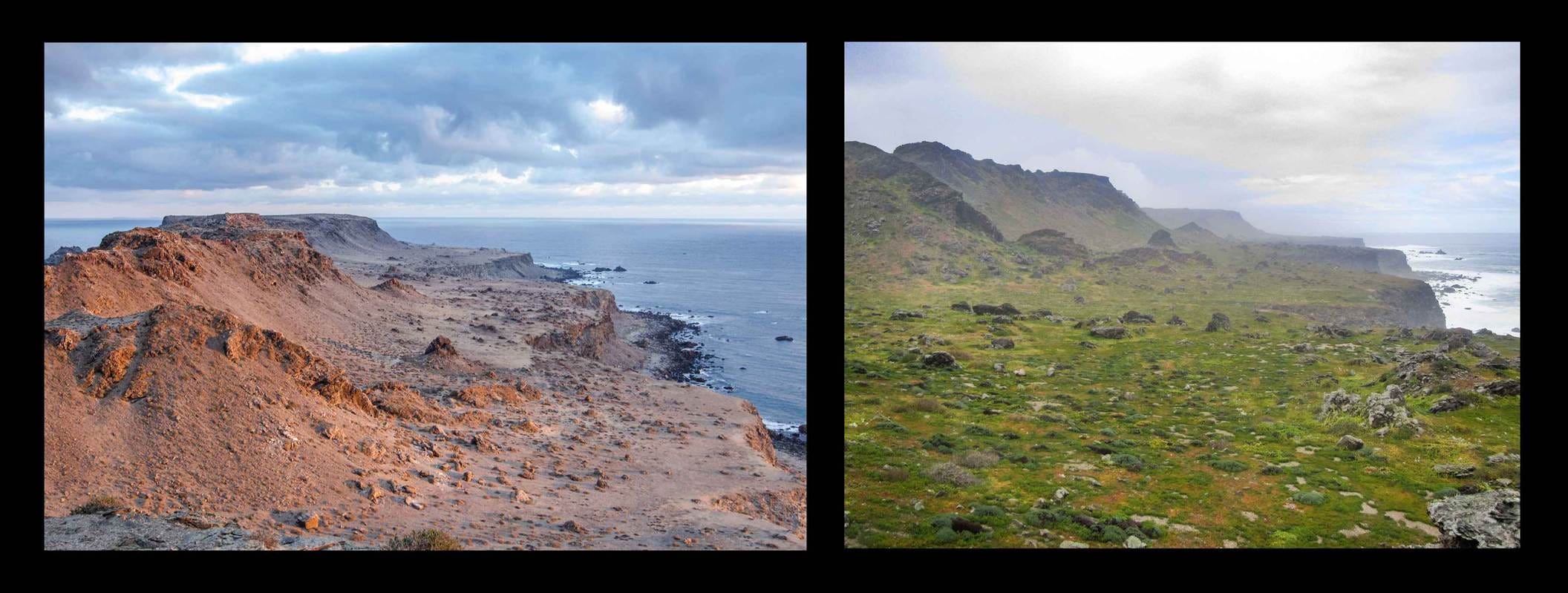
Before (left) and after (right) invasive rabbit eradication using brodifacoum-laced bait on Choros Island, off the coast of northern Chile (photo: Island Conservation).
IC: Looking ahead, what critical conservation priorities on islands should people be aware of?
TW: The public should be aware that arrogance and ignorance have aborted America’s most important island recovery project. And that this same arrogance and ignorance threaten other vital island recovery work.
About 4,000 ashy storm-petrels (half the planet’s population) face extirpation by alien house mice introduced by sealers to the Farallon Islands, 27 miles off San Francisco. In autumn, the ground undulates with mice. Sit down, and they crawl all over you.
Still, this National Wildlife Refuge sustains the biggest seabird rookery in the contiguous states. Before the mouse infestation, burrowing owls rested briefly on their fall migration. Now they linger into winter, gorging on mice. With seed shortage, mice turn to cannibalism, then starve. So owls switch to ashy storm-petrels. Enough mice survive that their population explodes again when new seeds appear in spring.
If mice remain, petrels will be eliminated. Meanwhile, mice expose sea lions and seals to dangerous pathogens, spread seeds of invasive plants, devour pollinators of native plants and consume two rare species found nowhere else -- Farallon camel crickets and Farallon arboreal salamanders.
Since 2004, the U.S. Fish and Wildlife Service and Island Conservation have tirelessly attempted to restore ecological health to the refuge. But they’ve been blocked at every turn by people who oppose use of all poisons in all situations no matter what.
For example, Maggie Sergio, formerly with the group WildCare, proves the old saw that one concerned citizen can make a difference. She proves also that this isn’t always a good thing. Sergio has whipped the City of San Francisco, the California Coastal Commission, animal rights outfits and the public to a froth of fear and loathing. As of early December 2025, her online petition against mouse eradication has 40,171 signatures.
Sergio’s screeds in the Huffington Post and elsewhere include such fiction as: “1.3 metric tons of brodifacoum” will be dropped by helicopter. (There isn’t enough brodifacoum in the world to drop 1.3 metric tons; 1.54 ounces would be dropped, this to be mixed with 1.3 metric tons of grain.) And: “The pesticide label for ‘Brodifacoum 25’ indicates that up to 24 [sic] pounds per acre will be applied.” (No, “Brodifacoum 25” contains 25 parts brodifacoum per million parts grain.)
These and/or other untruths are recycled by the media, the city, WildCare and the Ocean Foundation. One might suppose that this last group would defend ocean mammals and rare ocean birds. Instead, it frets about possible minor by-kill of super-abundant western gulls and “cruelty” to mice (as if allowing them to starve and eat each other is more humane).
So now, after 21 years of the Fish and Wildlife Service and Island Conservation attempting to recover the Farallon National Wildlife Refuge, the project appears permanently dead.
Thanks for this Ted. I used to be a “never poison” person in regard to non-native invasive plant removal. I watched my hard work quickly swallowed back up. Realizing what I was doing was not working I did some homework and have landed on triclopyr as my main go-to product for the woody/stemmy invasives we have here in southern Missouri. I still try to reduce the amount of poison i need to use by doing as much manual removal as possible, some burning off and working with the seasons. As gifts I give my friends bingo daubers with triclopyr and food coloring when they tell me they’re cutting down callery pear or autumn olive for example. My plan is to start a native plant nursery and help people get control of their yards and start giving wildlife the native food sources they need. If any resources come to mind that might be helpful to me please send them my way. Thanks again!