
How Glyphosate Saves Fish
What’s behind all the glyphosate hysteria, and why should it worry anglers?

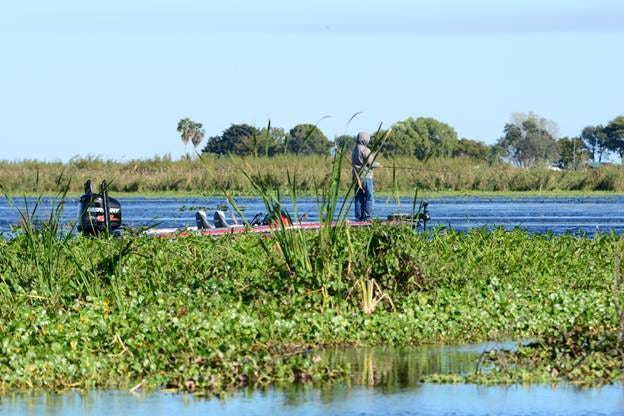
Floating, mobile tussock mat containing native smartweed, non-native hydrocotyle and native but invasive cattail. Managers treat these mats with glyphosate to prevent them from shading out and killing native stands of emergent bulrush, spike rush and submerged eelgrass, pepper grass, all important fish habitat. Photo by Capt. David Blinken
by Ted Williams
“CANCER WARNING, Roundup [glyphosate] weed killer,” shouts a typical ad, one of thousands on TV and social media. “You may be entitled to financial compensation. Call Knightline Legal…”
Virtually everything most Americans think they know about glyphosate -- the active ingredient in products like Roundup -- is wrong. That’s because social media and lawyer ads offering to sue Bayer -- owner of Monsanto, glyphosate’s original manufacturer -- are rife with misinformation.
What most Americans don’t know about glyphosate is that it’s often the only option for saving native fish and wildlife from alien plants. When non-native plant infestations replace habitat, fish and wildlife don’t just “go somewhere else.” They die. That’s why boots-on-the-ground environmental outfits like The Nature Conservancy (TNC) depend on glyphosate. It uses 19 herbicides to save and restore fish and wildlife habitat, glyphosate far more than the other 18.
No herbicide has been studied longer, proven safer, or used more than glyphosate. But fear and loathing of glyphosate has created big business for lawyers and a fundraising bonanza for shoes-in-the-office environmental outfits.
-------
When non-native plant infestations replace habitat, fish and wildlife don’t just “go somewhere else.” They die.
-------
In 2015, with no original research, the International Agency for Research on Cancer (IARC), a semi-autonomous, vestigial appendage of the World Health Organization, placed glyphosate on its speculative list of “probable carcinogens” right up there with “red meat” and “hot beverages.” It did so even though all scientific authorities in the world that have done original research, including its parent the World Health Organization and the United States Environmental Protection Agency, report no link to any form of cancer. More than 800 peer-reviewed papers confirm this fact.
According to the international news agency Reuters, IARC “edited findings from a draft of its review of the weedkiller glyphosate that were at odds with its final conclusion.”
The same week IARC published its outlying opinion Christopher Portier, special adviser for the group’s review, signed on as a litigation consultant for counsel suing Monsanto on behalf of people claiming that glyphosate had given them cancer. He reportedly got $450 per hour. This was before Monsanto was acquired by Bayer.
IARC’s opinion convinced California to require that all glyphosate products carry a cancer warning. But on February 26, 2018 a federal judge struck down the requirement, ruling it “inherently misleading…when apparently all other regulatory and governmental bodies have found the opposite.”
-------
Boots-on-the-ground environmental outfits like The Nature Conservancy depend on glyphosate. It uses 19 herbicides to save and restore fish and wildlife habitat, glyphosate far more than the other 18.
-------
Still, in August 2018 and March 2019 lawyers used IARC’s speculation and Portier’s testimony to convince two California juries that their clients had contracted non-Hodgkin lymphoma from glyphosate. Monsanto was ordered to pay $78 million to Dewayne Johnson, then $80 million to Edwin Hardeman -- verdicts that convinced Los Angeles County to ban glyphosate.
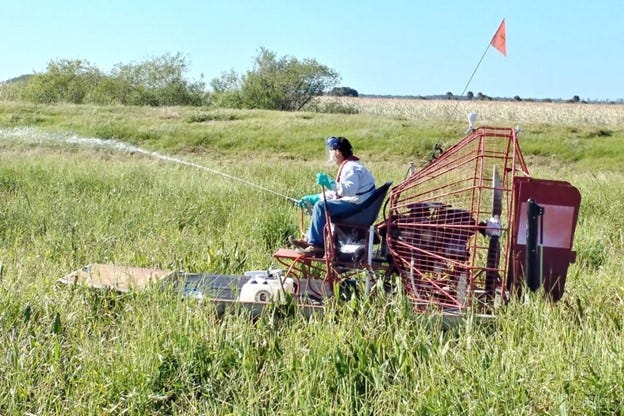
An airboat operator applies glyphosate to invasive West Indian marsh grass on a Florida lake. Photo by Stephen F. Enloe, University of Florida Agronomy Department/Center for Aquatic and Invasive Plants
So began the current lawyer feeding frenzy, which has resulted in at least 11,000 similar lawsuits.
Based entirely on IARC’s speculation, there have been glyphosate bans or restrictions in 28 nations as well as municipalities and counties in 15 U.S. states. And Bayer has paid $11 billion to settle lawsuits brought by cancer victims blaming their illnesses on Roundup.
This from Dr. Lee Van Wychen, science director for the National and Regional Weed Science Societies: “IARC’s review was such a crooked scam. I’ve never seen anything like it. IARC cherry-picked a couple studies and on top of that fudged the results … Now there are people on the conservation side who are afraid to use glyphosate.”
Still, local bans on all glyphosate use are proliferating, and pressure is mounting for a national ban.
-------
Americans have trouble keeping two thoughts in their brains simultaneously: 1. Glyphosate has been grossly abused by agribusiness; 2. Without glyphosate use by trained fish and wildlife professionals, the battle to save fish and wildlife from habitat destruction by invasive plants is lost.
-------
********
Despite popular nomenclature, native aquatic plants (which disgust ecologically challenged swimmers) are rarely “weeds.” Most serve fish and other aquatic organisms the way native trees and understory serve terrestrial life, recycling nutrients, slowing sediment transport and producing oxygen, cover and food.
Glyphosate formulations labeled for aquatic weed control include Rodeo, Shore-Klear, Pondmaster, Toughdown Pro, AquaPro, AquaNeat and Avocet. No herbicide may be so labeled if it has more than one in a million chance of harming humans, fish or any nontarget organism other than plants.
Whenever possible, it’s always better to remove weeds mechanically. But it is not always or even usually possible.
“LD50” stands for the lethal dose that kills half the test animals per unit of mass. Higher is safer. For rats caffeine’s LD50 is 192 mg/kg, glyphosate’s 5,600. Glyphosate acts on plants by inhibiting an enzyme needed to make three amino acids. Humans and other animals do not make or use this enzyme, so glyphosate cannot poison them.
********
-------
Whenever possible, it’s always better to remove weeds mechanically. But it is not always or even usually possible.
-------
Nowhere is glyphosate more desperately needed than in the alien hell that is Florida.
Don Fox of the Florida Fish and Wildlife Conservation Commission toured me by airboat around Lake Okeechobee, the heart, lungs, and kidneys of the Everglades. What happens here affects life all the way to and in Florida Bay.
Fish, alligators and turtles swirled from our path. Ospreys hovered, snail kites wheeled, and a manatee that had negotiated the entire St. Lucie canal sashayed over a shallow bar. A wide, half-mile-long swath of brown, withered cattails marked the area Fox had sprayed with glyphosate. Cattails are native, but the huge slug of phosphorus from dairy farms and ag land renders them invasive.
“They’re good guys gone bad,” Fox told me. “If we didn’t use glyphosate, cattails would crowd out native vegetation, and organic sediments would build up, causing anaerobic conditions. We’d lose our invertebrate communities, and that would magnify up to forage fishes and gamefishes.”
Glyphosate is especially effective for combatting giant salvinia, infesting waterbodies throughout the South. Few, if any, aquatic weeds are more deadly to fish than this free-floating, duckweed-like fern. “It just explodes,” says Dr. Wes Neal of the Mississippi State University Extension Service. “If not sprayed, it takes over, shading out sunlight, depleting oxygen and killing fish.”
Without glyphosate non-natives like water hyacinth and torpedograss would proliferate from Florida to Texas. They’d create huge mats that would smother such natives as bulrush and knotgrass -- spawning, nursery and foraging habitat for catfish, bass, crappie, bluegill and redear sunfish.
-------
Glyphosate acts on plants by inhibiting an enzyme needed to make three amino acids. Humans and other animals do not make or use this enzyme, so glyphosate cannot poison them.
-------
********
Phragmites, a non-native, deep-rooted reed that spreads through wind-blown seeds and rhizomes, blights America’s three coasts and inland waters. It pushes out native wetland plants and with them fish, birds, mammals, reptiles, amphibians and the complex food webs that sustain them. About two-thirds of all sport and commercial fish depend on coastal wetlands at some point in their lives.
Ninety-five-thousand-acre Utah Lake is a major water source for the Great Salt Lake. If it dries up or sickens, it takes the Great Salt Lake with it. Fifteen years ago, it was dying. Glyphosate saved it.
Utah Lake now sustains robust populations of largemouth bass, smallmouth bass, white bass, channel catfish, walleyes, northern pike, yellow perch, black bullhead, bluegill, sundry forage fishes, and the federally threatened June sucker. Before glyphosate treatments, the June sucker was listed as federally endangered.
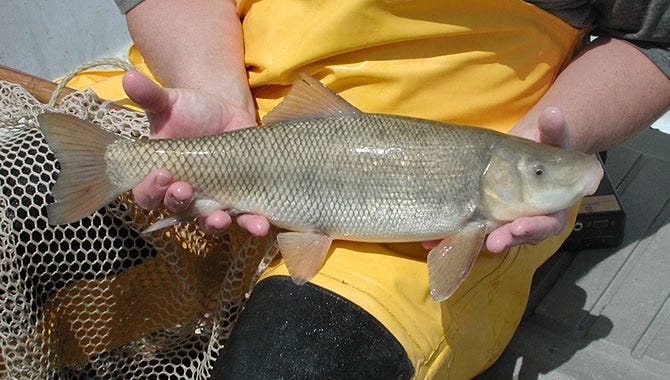
June sucker. Photo courtesy of Utah Lake Commission
And Utah Lake’s brackish water and extensive wetlands make it one of North America’s most important staging areas for migratory water birds. The watershed also provides habitat for a host of other birds, mammals, amphibians and reptiles.
Fifteen years ago, all this biodiversity appeared doomed by an explosion of phragmites. It grew out to four feet in water and all the way to the transitional zone of dry land.
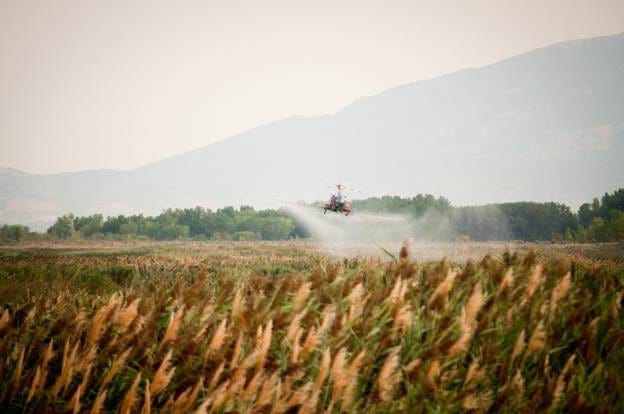
Glyphosate applied to Utah Lake’s phragmites infestation.
Photo courtesy of Utah Department of Agriculture and Food
So thick was Utah Lake’s infestation that wildlife couldn’t move through it and anglers, swimmers and boaters couldn’t access the lake. Phragmites created fire hazards, sucked vast amounts of water from the already diminished lake, and generated swarms of mosquitoes by blocking water flow.
All but tiny infestations of phragmites can’t be cut or bulldozed, leaving herbicide the only option. Dead stalks are then crushed or burned to make new growth visible for retreatment.
Spraying with glyphosate formulations began in 2009. “Each year, managers would focus on a different area,” reports the Utah Department of Agriculture and Food. Every area of the lake got three consecutive years of the spray-and-trample treatment.
Today, fish, wildlife, and human access have been restored. Glyphosate has eradicated most of the phragmites and future applications will kill most of what’s left.
Revegetation started last spring. With help from local organizations, the Utah Lake Authority planted 7,500 native seedlings. Before the end of 2024 “planting parties” of 400 volunteers planted about 10,000 more.
“For the lake,” says Luke Peterson, director of the Utah Lake Authority, “this is a turning point.”
********
Glyphosate hysteria in Florida spawned an online petition entitled “Stop the State-sanctioned Poisoning of Our Lakes and Rivers” still active and, at this writing (February 6, 2025), signed by 182,134 non-researchers. It’s illustrated with a jolly roger on a metal drum beside a dead spotted seatrout and dead forage fish. Glyphosate does not and cannot kill fish. It saves them from deoxygenation and habitat loss.
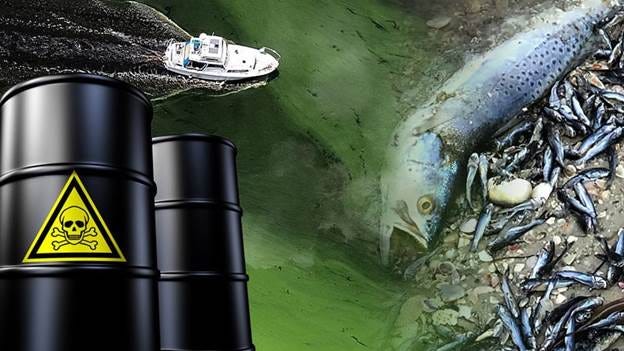
Illustration with online petition to ban glyphosate in Florida. Glyphosate does not and cannot kill fish. It saves them from deoxygenation and habitat loss.
On January 28, 2019 Florida responded to the petition by imposing a statewide moratorium on all aquatic herbicides.
The moratorium horrified organizations working to protect fish and other aquatic life. The Nature Conservancy warned of “serious economic and ecological consequences.” And Audubon Florida voiced strong support for glyphosate treatments in Lake Okeechobee.
“When a waterbody gets choked with vegetation that vegetation dies,” declares TNC’s Kristina Serbesoff-King. “The huge amount of decaying biomass takes out oxygen. That kills fish.”
LeRoy Rodgers, invasive species biologist with the South Florida Water Management District, tells me this: “In 1986 Florida also had a herbicide moratorium, and in a few short months our lakes and flow-ways were choked with exotic plants. We had to use triple the amount of herbicide we’d used at maintenance mode. It’s unfortunate that people without an understanding of weed management jump to conclusions and miss the big picture.”
On March 4, 2019 reason prevailed, and Florida lifted the moratorium. But five days earlier the City of Miami banned glyphosate.
********
-------
“When a waterbody gets choked with vegetation that vegetation dies. The huge amount of decaying biomass takes out oxygen. That kills fish.”
-------
Provided it’s green, what takes over aquatic and terrestrial ecosystems doesn’t much matter to the public, media or even a large element of the environmental community. Human health, not fish and wildlife, is their issue. And they like to imagine that glyphosate is the reincarnation of DDT.
Part of it is misplaced aggression. Environmentalists hate Monsanto, once glyphosate’s major distributor. That’s because Monsanto unleashed neonicotinoids (biocides that wipe out pollinators) and because Monsanto bio-engineered “Roundup Ready” crops immune to glyphosate that let farmers blitz all ag land without targeting weeds.
Van Wychen offers this: “Farmers overused glyphosate. It was too good to be true. You could spray it any time. It was extra safe for the environment, and it killed almost any weed. The selection pressure they put on that herbicide was unparalleled in the history of weed control. When you apply the same herbicide on 200 million acres multiple times a year, a few weeds will get lucky and pass on their resistance.”
These “super weeds” require truly dangerous herbicides like dicamba, which when misused (as it often is) drifts long distances. In 2018 it killed crops on hundreds of untargeted Midwest farms.
Americans have trouble keeping two thoughts in their brains simultaneously: 1. Glyphosate has been grossly abused by agribusiness; 2. Without glyphosate use by trained fish and wildlife professionals, the battle to save fish and wildlife from habitat destruction by invasive plants is lost.
-------
Provided it’s green, what takes over aquatic and terrestrial ecosystems doesn’t much matter to the public, media or even a large element of the environmental community.
-------
Scientists, not vulturine lawyers and lay-populated California juries, determine the safety of herbicides.
But let’s assume that all the world’s legitimate scientific bodies are wrong, and that, as IARC claims, glyphosate is “probably” carcinogenic to the only group considered by researchers whose studies IARC looked at. That group is ag workers who applied glyphosate for years, often with no protective gear and at millions of times the concentrations used by fish and wildlife managers.
In that case, banning all glyphosate use -- including the minuscule amounts used to control invasive plants devastating aquatic and terrestrial ecosystems -- makes as much sense as banning dental X-rays because first responders at Chernobyl suffered radiation sickness.
- 30 -
Ted Williams writes rare books as well as articles for low-paying publications.
Ted - I did not know about your essays on this topic. I recently wrote my own. It begins at the point in your essay, near the end, at "Farmers overused glyphosate...." I don't know how much of my piece you will agree with (since I have a complementary approach to issues), but you might give it a try. An exploration of that partial zone of overlap between us.
https://bernardrfoy.substack.com/p/the-monarch-vs-the-herbicide