
Green Ranching
The Only Thing Wrong With Grazing Is That It’s Not Always Done Right

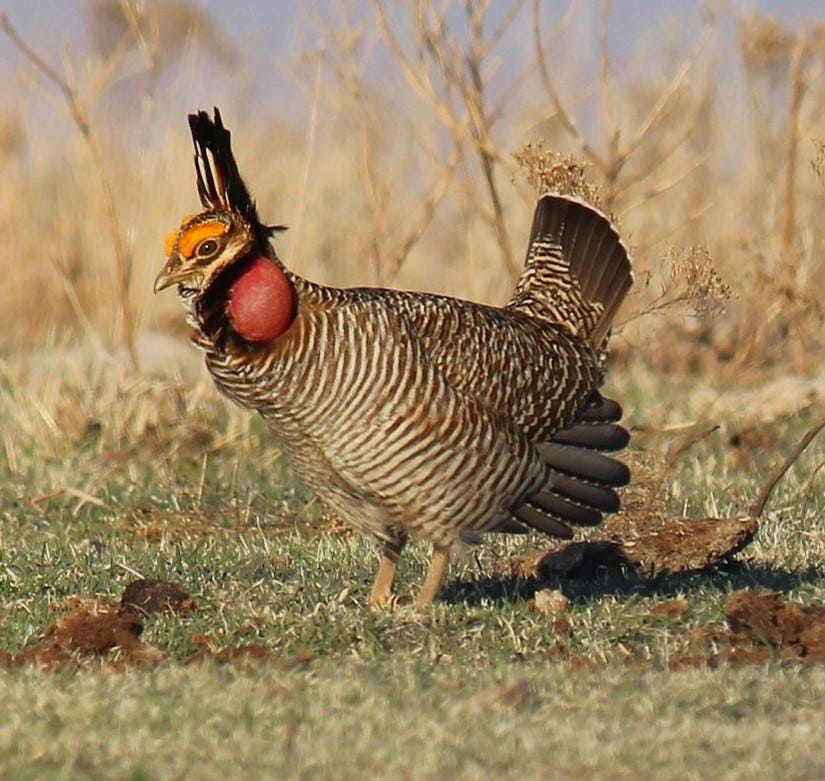
Lesser Prairie Chicken, another imperiled species that benefits from green ranching. Photo by Greg Kramos/USFWS
Ridding the West of cattle is the brainless, ecologically destructive priority of some organizations and individuals.
To wit:
“Ranching is one of the most nihilistic lifestyles this planet has ever seen. It should end. Good riddance,” proclaims Kieran Suckling, co-founder and executive director of the Center for Biological Diversity.
“Cattle grazing is environmentally destructive,” asserts WildEarth Guardians.
And this claim from Western Watersheds Project: “Livestock grazing drives the spread of invasive weeds and the decline of native plants, forcing wildlife to compete for diminishing forage and threatening entire ecosystems.”
These outfits do some good in their own ways. Witness the superb work of Western Watersheds Project’s deputy director Greta Anderson, in discovering dangerous inbreeding in critically endangered Mexican wolves and making it known to a clueless U.S. Fish and Wildlife Service.
They’d do lots more good if their anti-ranching factions spent more time on the western landscape, conversed with their imagined adversaries and focused less on the past.
Not that there still aren’t plenty of grazing abuses, but a new generation of green ranchers is restoring grasslands, repairing watersheds, reconnecting rivers and maintaining wildlife corridors.
And all ranchers, green and otherwise, preserve open space from subdivision. If they are forced off public lands, they’ll go out of business. Fish and wildlife will die as a result. Habitat can heal from overgrazing. It cannot heal from shopping malls and housing developments.
Ranching Gone Right
Shane Rosenkrance, a fifth-generation rancher who manages the Mountain Springs Ranch in central Idaho, offers this: “For the most part, the adversarial relationship with federal land managers is over. There’s a new era of cooperation. For instance, our new grazing plan called for so much monitoring that the Bureau of Land Management couldn’t quite do it. So I hired people to help. In the past, some ranchers did monitoring to challenge federal data. I thought that was a tremendous waste of energy and time. Why not work together and do more?”
Contrast Rosenkrance’s philosophy with the old mindset as enunciated by Oakley, Idaho rancher Winslow Whiteley (1910-1995). In 1990, Whiteley hosted me at his ranch to expand on his recent interview with The New York Times, in which he declared: “Either [Forest Service Ranger Don] Oman is gone or he’s going to have an accident. Myself and every other one of the permit holders would cut his throat if we could get him alone.”
Oman’s offenses were that he’d scolded the Wild Rose and Goose Creek allotments for gross grazing violations and disciplined (albeit mildly) the Pleasant Valley C&H allotment for yet grosser violations -- the first enforcement action against cattlemen in the history of the Sawtooth National Forest.
Representing the new breed of rancher, Rosenkrance protects streams and bottomland by restricting cattle to higher elevations. He adjusts fencing, water projects and plantings to accommodate wildlife. And he has helped organize an alliance of like-minded ranchers who call themselves the Central Idaho Rangeland Network.
Motivated by concerns for fish, Leadore, Idaho rancher Merrill Beyeler and other local ranchers reconnected tributaries to the Lemhi River, which had been desiccated by irrigation diversions.
This work required financial and/or technical support from Land Conservation Assistance Network (LandCan), Trout Unlimited, The Nature Conservancy (TNC), Shoshone-Bannock Tribes, the U.S. Fish and Wildlife Service, the Bureau of Land Management, U.S. Forest Service, Idaho Department of Fish and Game and other state and federal agencies.
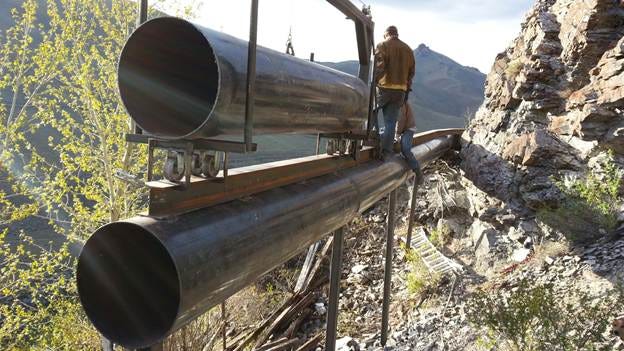
Bird Excavation LLC. and Cary Bird Welding installing a closed irrigation system on Hayden Creek, the Lemhi River’s largest tributary. Courtesy of Beyeler Ranches, LLC
Now, with colder water surging into the Lemhi, spawning, feeding and holding habitat for endangered Chinook salmon, endangered steelhead and threatened bull trout is expanding. And juveniles of all three species are moving into the reconnected tributaries.
“We had three goals,” Beyeler told me. “We wanted to quantify a good biological outcome, keep ranches intact, and stimulate the local economy. This kind of work takes a tremendous amount of planning and capacity. Our local contractors ended up with those bids. I cannot overstate the impact this conservation work has had on our valley.”
Leadore residents worried that their school, the state’s smallest, might go belly-up for lack of students and teachers. But people who grew up in town have come back, in large part to work on stream reconnections. Most have young children.
Boyd Foster, who does stream work with his backhoe service, saw the opportunity and moved back with his wife MariJill, who now teaches pre-school and kindergarten. With the expanded ranch and upturn in the economy, Beyeler’s three sons were able to return and now work with him on the ranch, and with them came a school infusion of 11 of Merrill’s 15 grandkids.
Also returning to Leadore and profiting from stream work have been Cary Bird Welding, Bird Excavation LLC, Peterson Metal Products, Two Dot Irrigation and Supply and Diamond X Post and Pole.
“What’s good for the bird is good for the herd,” declares Jay Tanner who, with his brothers Blaine and Brent, runs the Della Ranches in northwestern Utah. He’s referring to the greater sage grouse, which the three brothers, other green ranchers, NGOs, state and federal agencies are striving to recover before it declines to the point that the Fish and Wildlife Service is forced to list it under the Endangered Species Act.
For the Tanners’ leadership in a U.S. Fish and Wildlife Service program called Partners for Fish and Wildlife and their work for sage grouse and other wildlife, Della Ranches received the Environmental Stewardship Award and the Sand County Foundation’s Leopold Conservation Award.
Assisting the Tanners are LandCan, Intermountain West Joint Venture, Utah Open Lands, state agencies, federal agencies and academic institutions.
Cattle as Bison Surrogates
North American prairie plants evolved with bison, which pruned growth that would otherwise have turned to smothering matts of duff. Before Europeans arrived on the continent, fires never sterilized the earth because fuel didn’t have a chance to build up. And bison never stayed long enough in one place to do damage; they just moved on to fresh forage.
No one claims that well-managed grazing can fully replicate the ecological role of bison or large-scale wildfire, but it sure helps.
Responsible, sustainable cattle grazing mimics the past grazing of bison and produces more seeds, insects, and other important wildlife food than ungrazed or overgrazed land. Pretty much all Great Plains wildlife requires disturbance. These species evolved with millions of bison and lots of fire.
That’s why the U.S. Fish and Wildlife Service leases grazing allotments on national wildlife refuges. And that’s why TNC leases grazing allotments on its preserves.
At Chase Lake National Wildlife Refuge in North Dakota, I inspected a section ungrazed for 50 years. Neil Shook, then the refuge manager, and I hiked over a thick carpet of plant litter that felt like a quaking bog. It was rife with such invasive aliens as silverberry, buckbrush, Kentucky bluegrass, smooth broom, and Canada thistle.
But on grazed sections, we encountered a profusion of natives, including purple coneflower, yellow coneflower, blanket flower, purple prairie clover, prairie smoke, green needle, and little bluestem, all close to or on firm prairie soil.
As part of a birding festival, a group comes here each year. Early on, participants were undone by the presence of cows. “Isn’t that bad for wildlife?” they asked Shook. He set them straight by showing them what he showed me.
The Lesser Prairie Chicken Example
Lesser prairie chickens, to mention just one example of hundreds, depend on the right kind of cattle grazing, as I learned when I toured the ranches surrounding TNC’s 7,200-acre Yoakum Dunes Preserve in Texas. Overgrazing degrades lesser prairie chicken habitat, taking out residual cover, but that doesn’t happen much now in these parts.
Without moderate disturbance, grasslands are quickly invaded by trees like mesquite and eastern red cedar. Not only do trees provide unnatural perches and unnatural nesting sites for avian predators, they shade out forbs and grasses and fill in courtship leks, rendering lesser prairie chicken reproduction impossible.
Shinnery oak is a component of good lesser prairie chicken habitat because it provides heat protection and acorns, an important food source. But even shinnery oak can get too high and too thick. And tree invasion is being exacerbated by human suppression of wildfire.
The birds on Yoakum Dunes would not be prospering -- in fact, might not even be there -- without the well-managed ranches that surround it and which bring habitat to something like 30,000 acres. TNC has brought cattle onto the preserve itself.
Assisting the local ranchers with lesser prairie chicken management are TNC, LandCan, North American Grouse Partnership, New Mexico Land Conservancy and Playa Lakes Joint Venture, Pheasants Forever and Quail Forever.
The problem isn’t too much grazing, it’s not enough of it. As it is, TNC has to do prescribed burns and herbicide treatments. About 98 percent of Texas is privately owned. In the lesser prairie chicken’s five-state range, the figure is something like 70 percent. This means that without landowner cooperation in habitat maintenance and restoration, the species hasn’t got much of a chance.
But that cooperation is happening. Prescribed burns, herbiciding, water-source development, and other ranching improvements that benefit cattle, lesser prairie chickens and other wildlife are being funded by the USDA’s Natural Resources Conservation Service (NRCS), via EQIP (Environmental Quality Incentive Program) and WHIP (Wildlife Habitat Incentive Program), and by the Fish and Wildlife Service’s Partners for Wildlife program.
What’s more, the NRCS has initiated a multi-agency partnership called the Lesser Prairie-Chicken Conservation Initiative that intensifies and streamlines this effort by identifying what good prairie chicken habitat looks like and by providing increased financial and logistical assistance to landowners to help them create it.
One might suppose that organizations decrying grazing abuses would support ranchers, NGO officials and federal resource managers who implement and promote responsible, sustainable grazing -- id est, profile them as models for better behavior.
But whenever I ask anyone engaged in green grazing if they’ve received a single word of encouragement from the Center for Biological Diversity, WildEarth Guardians or Western Watersheds Project, the answer is always no.
Instead, the good guys get lined up and shot with the usual suspects.
Ted Williams writes rare books, as well as articles for low-paying publications.
Mr. Williams: Take a look at this article. I think it will cause you to rethink your stance.
"Ecological Costs of Livestock Grazing in Western North America." Thomas L. Fleischner.
Conservation Biology, Vol. 8, No. 3. (Sep., 1994), pp. 629-644.
Can’t agree on this one, Ted. I did write about a “green” rancher back in the 1990s for Sports Afield but I don’t share your enthusiasm for this rural elite. I’m with the great Western historian Donald Worster.